UK:
UK: 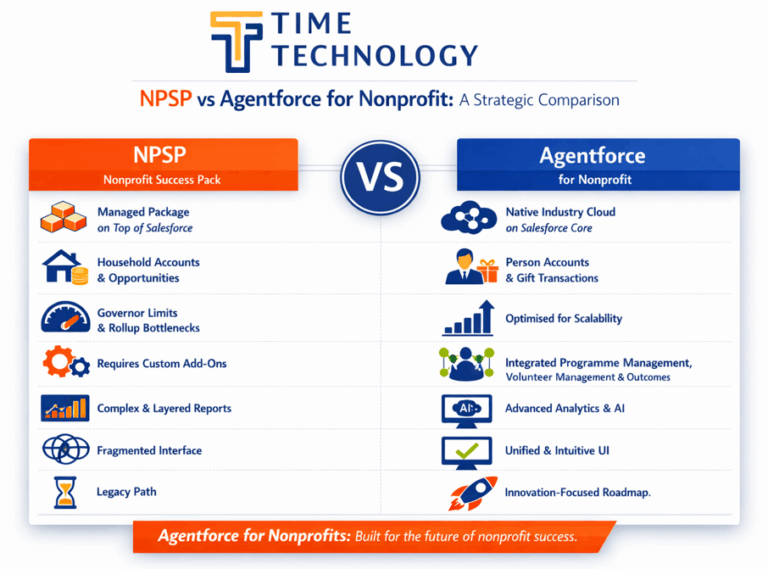
For nearly two decades, Salesforce Nonprofit Success Pack (NPSP) has been one of the most influential forces in the nonprofit technology sector. Long before digital transformation became a strategic priority, NPSP helped charities adapt Salesforce’s commercial CRM to better understand donors, households, recurring gifts, and the operational realities of fundraising.
What began as the Nonprofit Starter Pack—a community-built extension—evolved into a globally adopted framework, supported by Salesforce.org, partners like Time Technology and a vibrant open-source community. It introduced concepts that became sector standards:
- Household Accounts
- Soft credits and rollups
- Recurring Donations
- Engagement Plans
- Fundraising-ready reports and dashboards
These innovations made Salesforce accessible to Nonprofit organisations that lacked the budget or technical capacity to build a CRM from scratch. NPSP became one of the most widely deployed nonprofit CRM architectures in the world—its footprint visible across charities of every size and mission.
Over time, however, the very architecture that made NPSP possible also became the reason Salesforce had to evolve.
But before we get into that… it’s worth saying up front that there’s nothing forcing nonprofits to move away from NPSP. Salesforce continues to support it, and for many organisations, it still does the job well. The decision to migrate isn’t about compliance or deadlines — it’s about strategy. The shift to Agentforce for Nonprofits is an opportunity to modernise, align with Salesforce’s evolving architecture, and position your organisation for the future, not a requirement imposed from above.
When a Managed Package Reaches Its Limits
NPSP is, at its core, a managed package—a layer of functionality installed on top of Salesforce. This model was ingenious in the early years, enabling rapid innovation without requiring Salesforce to redesign its underlying data model. NPSP itself was supplemented with additional managed packages for Program Management (PMM), Case Management (CMM), Outbound Funds (OFM), and Volunteers for Salesforce (V4S), which layered additional functionality and extended the data model.
Yet as nonprofits grew more sophisticated, the constraints became harder to ignore:
- Performance bottlenecks at scale
- Complex rollup logic that strained automation limits
- Data structures that were difficult to extend cleanly
- A fundraising model built on Opportunities—never designed for nonprofit accounting
- Technical debt accumulating with each new customisation
NPSP didn’t fail. It simply reached the limits of what a managed package can be. Salesforce recognised this—and made a strategic pivot.
The Shift to Industry Clouds: Enter Agentforce for Nonprofits (AFNP)
Salesforce’s long-term roadmap is now anchored in Industry Clouds: native, core-level data models designed for specific sectors. For nonprofits, this is Agentforce for Nonprofits (AFNP), previously called Nonprofit Cloud (NPC).
AFNP is not an upgrade to NPSP. It is a fundamental re-architecture of how nonprofit data should work on Salesforce.
Where NPSP layered functionality on top of the platform, AFNP is built into it. This shift unlocks capabilities that were simply impossible before:
- A unified data model for fundraising, programmes, case management, volunteer management and outcomes
- Person Accounts and Party Relationship Groups replacing the more fragile Household model
- Gift Transactions and Gift Commitments enhance handling of one-off and recurring gifts
- More scalable automation and fewer governor-limit issues
- A foundation built for AI, analytics, and cross-programme insight
- Access to innovations from other industry clouds, such as Finance and Healthcare.
AFNP is the first version of Salesforce truly designed for the modern nonprofit.
Six Compelling Reasons to Move from NPSP to AFNP
1. Salesforce’s Innovation Is Now Focused on AFNP
Salesforce’s R&D investment has moved decisively to Industry Clouds. NPSP will remain supported, but it is no longer evolving. For organisations planning their next decade of digital capability, AFNP is the only architecture aligned with Salesforce’s future. The pace of innovation in AFNP has never been faster.
2. AFNP’s Native Core Architecture Removes NPSP’s Structural Constraints
By being built directly on Salesforce Core, AFNP eliminates the limitations of a managed package:
- Faster performance
- More reliable automation
- Cleaner extensibility
- Reduced technical debt
This is especially critical for organisations with large datasets or complex operations.
The industry-focused model also allows nonprofits to leverage commercial innovation.
3. A Unified, Modern Data Model
AFNP reflects how nonprofits actually operate today. It unifies fundraising, programmes, volunteers and outcomes on a single architecture, enabling:
- Person-centric data
- Richer relationship modelling
- Accounting-grade gift tracking
- Cross-team collaboration
This is the data foundation nonprofits have been asking for.
4. Better Reporting, Analytics, and AI Readiness
AFNP’s data model is designed for:
- Cross-programme reporting
- Fundraising analytics that reflect real-world giving patterns
- Outcome measurement
- AI-driven insights
NPSP’s layered architecture makes advanced analytics harder and more fragile. AFNP makes them natural.
Agentic AI is at the heart of AFNP innovation, offering a genuine opportunity to increase mission capacity.
5. A More Consistent User Experience
AFNP reduces friction for staff by offering:
- More intuitive data structures
- Fewer custom objects and workarounds
- A more consistent experience across teams
User adoption improves because the system finally matches how nonprofits think and work.
6. Future-Proofing the Organisation
AFNP is not just a technology shift—it’s a strategic one. It positions nonprofits for:
- Organisational resilience
- Data maturity
- Cross-team collaboration
- Long-term platform alignment
- The ability to adapt to future Salesforce innovation
NPSP was built for the last decade of nonprofit CRM. AFN is built for the next one. Reducing technical debt isn’t just an operational question; it’s a strategic imperative.
The Strategic Moment for Nonprofits
The nonprofit sector is entering a new era—one defined by data-driven decision-making, rising expectations from funders, and the need for integrated, organisation-wide insight. AFNP is the architecture designed for this world.
If your NPSP Org accurately and efficiently supports your current processes, and you are not looking to add support for a new business area, new internal or external audiences to Salesforce, or new complex integrations, there is no rush to migrate to AFNP. However, the question is no longer whether to move, but when and how. The organisations that act early will gain the greatest advantage: cleaner data, stronger insight, and a platform aligned with Salesforce’s future—not its past.
The second part of this blog series will describe what migrating from NPSP to AFNP might look like for your organisation.